
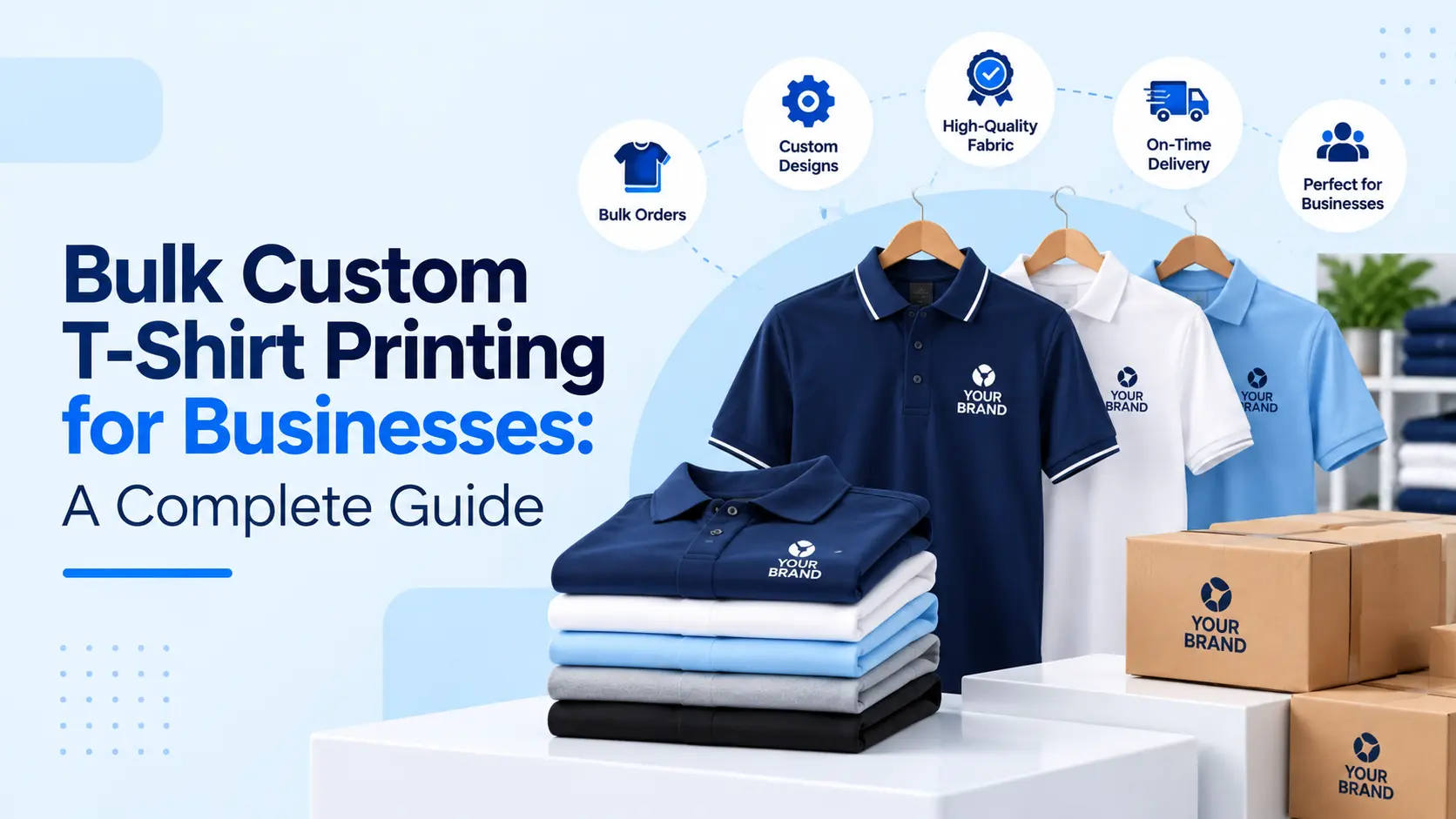
Customised T-shirts have become an important part of modern business branding. From employee uniforms and promotional campaigns to corporate events and exhibitions, businesses use branded apparel to create a consistent identity and improve brand visibility.
For organisations looking to outfit large teams or promote their products and services, bulk custom T-shirt printing offers a practical solution. Instead of ordering individual garments, businesses can plan their requirements together and customise T-shirts according to their branding preferences.
However, choosing the right T-shirts for bulk orders requires more than selecting a colour and adding a company logo. Fabric quality, printing methods, sizes, pricing and delivery timelines all play an important role.
In this guide, we will explore everything businesses should know before ordering custom printed T-shirts in bulk.
Bulk T-shirt printing is useful for organisations with multiple employees, departments, branches or promotional requirements.
Here are some important advantages.
Branded T-shirts help businesses maintain a consistent appearance across their teams. When employees wear matching apparel featuring the company logo and colours, it creates a recognisable brand identity.
This is particularly useful for companies with customer-facing employees, field teams and multiple business locations.
Ordering T-shirts in bulk can offer better pricing opportunities compared with purchasing smaller quantities separately.
Depending on the supplier, printing method, fabric and order quantity, businesses may receive more competitive per-unit pricing for larger orders.
Custom printed T-shirts can act as promotional merchandise. Employees wearing branded apparel at exhibitions, trade shows, product launches and public events can help introduce the business to new audiences.
Bulk customised T-shirts can be used for employee uniforms, corporate celebrations, promotional campaigns, team activities, sporting events and marketing giveaways.
Fabric selection is one of the most important decisions when placing a bulk T-shirt order.
The right material can improve comfort, durability and the overall appearance of the finished product.
Cotton is widely used because of its softness and breathability. It is suitable for everyday corporate apparel and casual promotional T-shirts.
Polyester is lightweight, durable and generally dries faster than cotton. It can be suitable for sports events, outdoor activities and employees who require lightweight apparel.
Blended fabrics combine cotton and polyester fibres. Depending on the composition, they can provide a balance of comfort, durability and easy maintenance.
When selecting fabric, businesses should consider the intended usage, weather conditions, product quality and available budget.
Different businesses have different requirements when it comes to branded apparel.
Some popular styles include:
Round-Neck T-Shirts
These are suitable for promotional campaigns, corporate events, team outings and casual employee wear.
Polo T-Shirts
Polo T-shirts offer a more professional appearance with their collar design. They are commonly selected for office uniforms, retail teams and sales employees.
Oversized T-Shirts
Oversized styles are suitable for casual merchandise collections, youth-oriented brands and certain promotional campaigns.
Sports T-Shirts
Lightweight sports-style T-shirts are useful for corporate sports events, fitness activities and outdoor team programmes.
Choosing a style that suits your company’s purpose helps ensure that the apparel is both practical and visually consistent.
The printing method directly influences how your company logo and design appear on the finished T-shirt.
Here are some commonly used options.
Screen printing is widely used for bulk orders, particularly when the design has consistent colours and does not require extensive individual personalisation.
It can be a suitable option for corporate uniforms and promotional T-shirts.
Heat transfer printing applies a design to the garment using heat and pressure. It can be useful for certain detailed graphics, names and customised designs.
Embroidery creates a stitched logo directly on the garment. It is particularly popular for polo T-shirts and premium corporate apparel because of its textured appearance.
Before selecting a method, consider the design, fabric compatibility, order quantity and intended usage.
A professional design is essential for creating quality branded apparel.
Before sending artwork to the printing supplier, businesses should prepare their branding requirements carefully.
Consider the following:
Use a high-resolution company logo.
Provide the correct brand colours.
Decide the preferred logo placement.
Confirm the required print size.
Share any additional text or design elements.
Review the final mock-up before production.
For the best results, provide vector artwork where possible, such as AI, EPS or SVG files, depending on the supplier’s requirements.
A clear design file helps reduce printing errors and improves consistency across the order.
Accurate quantity planning helps businesses avoid unnecessary expenses and last-minute shortages.
Start by identifying who will receive the T-shirts and how they will be used.
For example, a company ordering T-shirts for 100 employees should collect size preferences before confirming the order.
Consider these factors:
Employee Count: Calculate the number of people who need corporate apparel.
Size Distribution: Prepare a size-wise quantity list covering the required sizes.
Extra Stock: Consider whether additional pieces are needed for new employees or replacements.
Department Requirements: Different departments may need different colours or designs.
Event Requirements: For exhibitions and promotional campaigns, estimate the expected number of recipients.
A properly prepared size and quantity list makes bulk ordering easier to manage.
The price of a customised T-shirt depends on several factors.
Fabric Type: Different materials have different price ranges.
T-Shirt Style: Polo, round-neck and premium styles may have different costs.
Order Quantity: Larger orders may offer different per-unit pricing.
Printing Method: Screen printing, heat transfer and embroidery have different production costs.
Design Complexity: The number of colours, print positions and artwork details can affect pricing.
Additional Customisation: Individual names, special packaging and other requirements may increase the overall cost.
When requesting a quotation, share all your requirements to receive a more accurate estimate.
Before finalising a supplier, make sure you review the following:
Request fabric samples to evaluate quality and comfort.
Check the available sizes and colours.
Confirm printing or embroidery options.
Review the logo placement and design mock-up.
Understand minimum order quantities.
Ask for a complete quotation.
Confirm production and delivery timelines.
Check quality inspection and replacement policies.
These checks help businesses make informed purchasing decisions and reduce the chances of unexpected issues.
Custom printed T-shirts are suitable for businesses across different industries.
IT and Technology Companies: Branded T-shirts for employees, internal events and company merchandise.
Retail and Hospitality: Matching apparel for store employees, restaurant staff and customer-facing teams.
Manufacturing and Industrial Businesses: Corporate T-shirts for staff, promotional events and company activities, with garment suitability considered for the working environment.
Educational Institutions: Customised T-shirts for college events, student programmes and institutional activities.
Marketing and Event Agencies: Promotional T-shirts for exhibitions, brand activations and marketing campaigns.
This flexibility makes bulk customised apparel a useful option for organisations of different sizes.
Finding a suitable corporate apparel supplier is an important part of planning a successful bulk order.
Corporate Collars helps businesses explore customised T-shirt and branded apparel solutions for employee uniforms, promotional campaigns, corporate events and other business requirements.
Whether you need bulk printed round-neck T-shirts, customised polo T-shirts or branded employee apparel, selecting the right combination of fabric, printing and design can help represent your business professionally.
Planning your next corporate apparel order? Contact Corporate Collars to discuss your requirements and explore suitable customised T-shirt options.
Your brand deserves to be seen. Make it visible with customised corporate apparel.
Minimum order quantities depend on the supplier, garment type and printing requirements. Contact the supplier to confirm available options.
Screen printing is commonly considered for larger orders with consistent designs. Embroidery is another popular option for premium corporate polo T-shirts.
Screen printing is commonly considered for larger orders with consistent designs. Embroidery is another popular option for premium corporate polo T-shirts.
Cotton, polyester and cotton-polyester blends are commonly used. The best option depends on comfort, durability, intended use and budget.
Many suppliers accommodate multiple sizes within a bulk order. Confirm the size range and size-wise quantity requirements before production.
Production time depends on the order quantity, fabric availability, design approval and printing method. Confirm the delivery schedule with your supplier before placing the order.
Businesses should provide the required quantity, T-shirt style, fabric preference, available sizes, colour, logo artwork and printing requirements to receive an accurate quotation.