
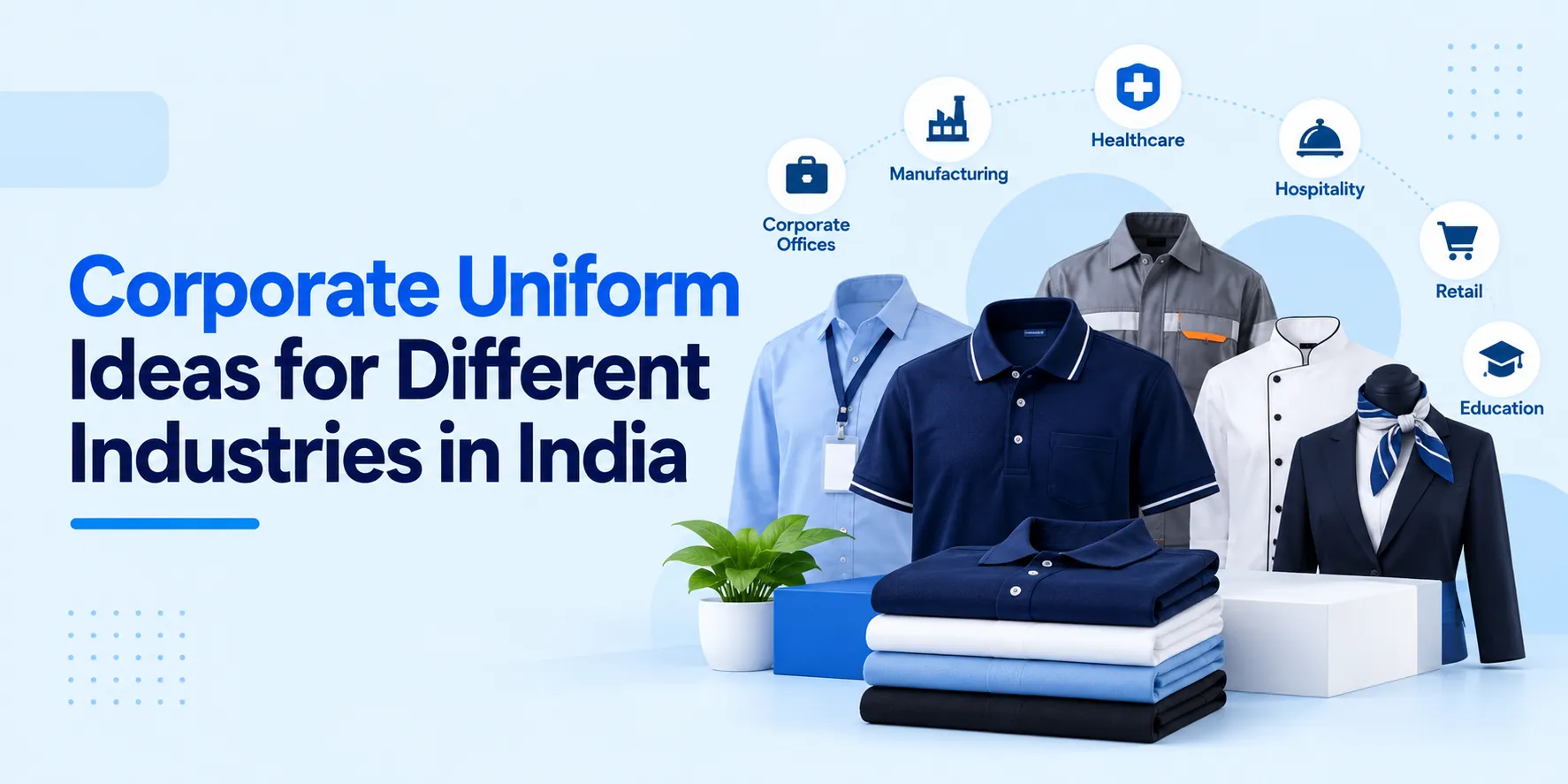
A corporate uniform is more than a set of matching clothes. It represents a company’s identity, creates a consistent professional appearance, and helps employees feel connected to their team.
In India, businesses across industries use uniforms for different purposes. IT companies may prefer smart-casual polo T-shirts, hospitality teams may require coordinated formal wear, and field employees may need comfortable clothing suited to outdoor work.
Choosing the right corporate uniform depends on the nature of the business, employee responsibilities, workplace conditions, brand identity, and budget.
A uniform that works well for an office team may not be suitable for employees who spend long hours outdoors or perform physically demanding tasks.
In this guide, we explore corporate uniform ideas for different industries in India, including suitable apparel styles, fabric considerations, customization options, and practical tips for businesses planning bulk orders in 2026.
Technology companies often prefer a modern, comfortable, and professional workplace appearance. Depending on their dress code, they may choose smart-casual apparel instead of traditional formal uniforms.
Polo T-shirts with a small company logo
Round-neck T-shirts for casual office environments
Premium branded T-shirts for employee merchandise
Hoodies for team events and informal workplace activities
Formal shirts for client meetings and corporate presentations
For employees who spend most of their day in an office, prioritize comfort, breathability, and a neat fit. Cotton and suitable cotton-blend fabrics can work well for everyday wear.
Choose colours that complement your company’s branding without making the uniform look overly promotional.
For startups, a simple branded polo or T-shirt can provide a consistent team identity without requiring a highly formal dress code.
Best choice: Branded polo T-shirts for smart-casual office wear and round-neck T-shirts for informal environments.
Employees in hotels, restaurants, cafés, and hospitality businesses interact directly with customers. Their clothing contributes to the overall guest experience and the establishment’s visual identity.
Uniform requirements may differ between reception staff, restaurant teams, kitchen employees, housekeeping personnel, and management.
Formal shirts for reception and guest-facing teams
Polo T-shirts for cafés and casual dining establishments
Coordinated shirts and trousers for restaurant staff
Branded T-shirts for food-service promotions and events
Suitable workwear designed for kitchen and housekeeping duties
Hospitality uniforms should balance appearance, comfort, ease of maintenance, and the demands of each role.
For customer-facing employees, choose coordinated colours and clean designs that reflect the establishment’s brand. For employees working in kitchens or other specialized environments, prioritize role-appropriate garments and applicable hygiene and safety requirements.
Best choice: Formal shirts for reception and management, and comfortable, easy-care apparel for casual service environments.
Retail employees help customers navigate products, answer questions, and complete purchases. Recognizable uniforms can make staff easier to identify and reinforce the store’s brand image.
Retail uniforms should look professional while allowing employees to move comfortably throughout their shifts.
Branded polo T-shirts
Formal shirts for premium showrooms
Coordinated T-shirts for promotional campaigns
Branded jackets for outdoor retail activities
Uniform tops in colours that complement store branding
Consider the retail environment and the type of customer experience the business wants to create.
A premium showroom may prefer formal shirts or polished polo T-shirts, while a casual retail outlet may choose simple branded T-shirts.
Ensure that employees can move comfortably, especially when their work involves standing, walking, stocking shelves, or assisting customers throughout the day.
Best choice: Polo T-shirts for everyday retail operations and formal shirts for more formal showroom environments.
Manufacturing companies require workwear suited to the tasks employees perform. Uniform selection should prioritize practical requirements rather than appearance alone.
Office employees, supervisors, warehouse staff, and production workers may all need different clothing.
Durable work shirts for suitable industrial environments
Polo T-shirts for office-based production teams
Branded T-shirts for company events
Appropriate workwear for warehouse personnel
Role-specific protective clothing where required
Consider the work environment, temperature, movement requirements, laundering frequency, and exposure to workplace hazards.
Standard corporate T-shirts are not a substitute for protective workwear. Employees working around machinery, chemicals, heat, or other hazards may require specialized garments and personal protective equipment based on a workplace risk assessment.
Company branding should never interfere with visibility, protective features, or safety requirements.
Best choice: Durable, role-appropriate workwear, with branded polos or shirts for office and supervisory teams where suitable.
Healthcare organizations have specific clothing requirements depending on the employee’s role and workplace.
Administrative staff, reception teams, hospital support staff, and other non-clinical employees may use coordinated corporate apparel. Clinical staff require clothing appropriate to their duties, hygiene practices, and institutional policies.
Formal shirts for administrative personnel
Polo T-shirts for suitable support roles
Branded apparel for health awareness campaigns
Coordinated clothing for administrative and reception teams
Role-specific uniforms for clinical and technical personnel
Comfort, ease of laundering, workplace hygiene, and role suitability should guide uniform selection.
Avoid treating all healthcare employees as having the same requirements. Clinical clothing, protective garments, and specialized uniforms must follow the organization’s applicable infection-control and safety policies.
For non-clinical teams, consistent colours and restrained branding can create a professional appearance.
Best choice: Formal shirts or suitable polo T-shirts for administrative teams, with specialized clothing selected separately for clinical roles.
Sales representatives and marketing professionals often move between offices, client meetings, exhibitions, and promotional activities.
Their uniforms should reflect the company’s identity while remaining comfortable for different working environments.
Polo T-shirts for field sales teams
Formal shirts for client-facing meetings
Branded T-shirts for exhibitions and promotional events
Lightweight jackets for travel and outdoor activities
Coordinated apparel for product launches and roadshows
Consider how frequently employees travel, the local climate, and the level of formality expected during customer interactions.
Polo T-shirts may suit field activities and casual meetings, while formal shirts can be more appropriate for traditional corporate environments.
Keep logo placement consistent across teams and choose garments that employees can wear comfortably for extended periods.
Best choice: Polo T-shirts for field activities and formal shirts for meetings that require a more traditional professional appearance.
Logistics businesses need apparel that supports movement, practical working conditions, and easy identification.
The requirements of warehouse employees, delivery teams, drivers, and office staff can vary significantly.
Polo T-shirts for suitable warehouse or support roles
Durable work shirts for operational teams
Branded apparel for drivers where appropriate
Jackets for employees working in cooler environments
High-visibility clothing where workplace risks require it
Prioritize freedom of movement, durability, comfort, and maintenance requirements.
For employees working outdoors or near vehicles, visibility and role-specific safety requirements are particularly important. Standard branded apparel should not replace required high-visibility garments or protective equipment.
Choose garments according to the work environment rather than applying one uniform design to every employee.
Best choice: Durable, comfortable workwear supplemented by appropriate safety clothing wherever required.
Schools, colleges, training centres, and educational organizations may use coordinated apparel for staff, events, outreach programmes, and institutional activities.
The appropriate style depends on the organization’s dress code and the employees’ responsibilities.
Formal shirts for administrative staff
Polo T-shirts for suitable support teams
Branded T-shirts for workshops and college events
Coordinated apparel for admission campaigns
Hoodies or T-shirts for institutional merchandise
Choose comfortable garments that suit the institution’s working environment and branding guidelines.
For workshops, conferences, and outreach programmes, customized T-shirts can help organizers and staff remain identifiable. For regular administrative duties, formal shirts or polo T-shirts may create a more professional appearance.
Best choice: Formal shirts for administrative teams and branded T-shirts for events, workshops, and outreach activities.
Event management teams frequently work across venues, conferences, exhibitions, product launches, and promotional campaigns.
Uniforms help identify organizers, coordinate teams, and create a consistent appearance during an event.
Branded round-neck T-shirts for event crews
Polo T-shirts for registration and coordination teams
Lightweight apparel for outdoor events
Jackets for events in cooler environments
Distinctive team colours for different operational groups
Event teams may spend long hours standing, walking, lifting equipment, or coordinating with attendees.
Choose breathable fabrics and comfortable fits suited to the activities involved. Consider placing the company or event name where it is easy to recognize.
If several teams are working at the same event, different garment colours can help distinguish responsibilities.
Best choice: Branded round-neck T-shirts for active event crews and polo T-shirts for registration or guest-facing staff.
Banks, consulting firms, insurance businesses, and professional service organizations may have more formal expectations for employee presentation.
Their uniform strategy should reflect the company’s culture and the nature of its customer interactions.
Formal shirts for client-facing professionals
Premium polo T-shirts for internal events
Coordinated branded apparel for conferences
Jackets for selected corporate events
Smart-casual T-shirts for informal team activities
The level of formality should match the organization’s dress code.
For regular client meetings, formal shirts may be more appropriate than casual T-shirts. For internal events, employee engagement programmes, and company outings, branded polos or round-neck T-shirts can provide a relaxed alternative.
Choose restrained branding and quality garments that support a polished appearance.
Best choice: Formal shirts for traditional client-facing environments and premium polo T-shirts for smart-casual events.
| Industry | Suggested apparel | Key priority |
|---|---|---|
| IT and technology | Polo T-shirts, round-neck T-shirts | Comfort and brand identity |
| Hospitality | Formal shirts, suitable polos | Appearance and ease of care |
| Retail and showrooms | Polo T-shirts, formal shirts | Customer-facing presentation |
| Manufacturing | Role-specific workwear | Durability and safety |
| Healthcare | Role-appropriate uniforms | Hygiene and workplace requirements |
| Sales and marketing | Polos, formal shirts | Versatility and comfort |
| Logistics | Work shirts, suitable polos | Movement and visibility |
| Education | Formal shirts, event T-shirts | Professionalism and versatility |
| Event management | Round-neck T-shirts, polos | Comfort and team identification |
| Finance and consulting | Formal shirts, premium polos | Professional appearance |
These recommendations are starting points rather than fixed rules. Actual uniform requirements depend on the workplace, employee duties, company policies, and local conditions.
Once you identify the right style for your industry, use the following checklist before placing an order.
Identify which employees need uniforms and how they will use them.
A garment designed for occasional events may not be suitable for daily wear. Consider the duration of wear, movement, work environment, and frequency of laundering.
Fabric choice affects comfort, durability, appearance, and maintenance.
Cotton and cotton blends may suit many office environments, while suitable performance fabrics can be useful for active roles. Specialized environments may require fabrics that meet specific safety or hygiene standards.
Choose materials based on the garment’s intended purpose rather than relying on one fabric for every department.
Select colours that align with your brand identity and determine where the company logo should appear.
Keep the design legible and professional. For teams working in different departments, consistent branding with variations in garment style or colour can help create a coordinated look.
Collect employee size requirements before placing a bulk order.
Use a reliable size chart and, where possible, arrange sample fitting. This helps reduce sizing errors and makes the final uniforms more comfortable for employees.
The cheapest garment may not be the best long-term choice if it loses its shape, fades, or becomes uncomfortable after repeated washing.
Compare fabric specifications, stitching, fit, branding quality, and expected usage when evaluating quotations.
Request a sample or production proof and confirm the garment colour, logo placement, size, and overall quality.
Make sure all relevant stakeholders approve the final specifications before production begins.
For large teams, agree on delivery schedules, size-wise quantities, packaging, and procedures for handling incorrect or damaged items.
If you expect to reorder uniforms as your company grows, document the garment specifications and branding requirements so future orders can remain consistent.
A well-planned uniform programme can support several business objectives.
Stronger brand recognition: Consistent colours and logos help employees present a recognizable brand identity.
Professional presentation: Coordinated clothing can create a more organized appearance during client meetings, events, and everyday operations.
Employee identification: Appropriate uniforms help customers and visitors identify staff in retail, hospitality, events, and other relevant environments.
Team identity: Shared apparel can support a sense of belonging during company events and group activities.
Practical consistency: Standardized garment specifications simplify ordering and help businesses maintain consistency across teams and locations.
Uniforms work best when they are comfortable, appropriate for the job, and selected with employee input where practical.
Choosing uniforms for multiple departments can be challenging. Businesses need to balance employee comfort, brand consistency, garment quality, customization, and cost.
Corporate Collars offers a range of apparel categories, including polo T-shirts, round-neck T-shirts, formal shirts, V-neck T-shirts, hoodies, and jackets. These options can help businesses explore different styles for office wear, corporate events, and branded team apparel.
The right selection depends on your industry, workforce, and intended use.
Before placing a bulk order, identify your requirements, review available products, confirm customization details, and request a sample where appropriate.
Planning corporate uniforms for your team?
Explore the Corporate Collars catalogue to review available apparel styles and discuss your business requirements.
Industries such as IT, retail, hospitality, healthcare, manufacturing, logistics, education, sales, and event management may use uniforms or coordinated employee apparel. The style and specifications depend on the nature of the work.
Polo T-shirts and formal shirts are common options for office employees. Polo T-shirts suit many smart-casual environments, while formal shirts may be preferable for businesses with traditional professional dress codes.
Breathable, lightweight fabrics are often useful in warm and humid conditions. Cotton, suitable cotton blends, and selected performance fabrics may work well depending on the activity and workplace. Consider local climate, comfort, durability, and care requirements before choosing.
Many corporate apparel products can be customized using suitable printing or embroidery methods. Available options depend on the garment, material, artwork, and supplier’s capabilities.
Document garment specifications, approved colours, logo artwork, size charts, and customization methods. Use these specifications for subsequent orders and review samples when products or suppliers change.
Businesses should confirm garment styles, fabric specifications, size distribution, branding, order quantities, sample approval, pricing, and delivery schedules. Planning these details in advance helps reduce mistakes and delays.
Businesses can explore the Corporate Collars catalogue for apparel categories such as polo T-shirts, round-neck T-shirts, formal shirts, hoodies, and jackets.